
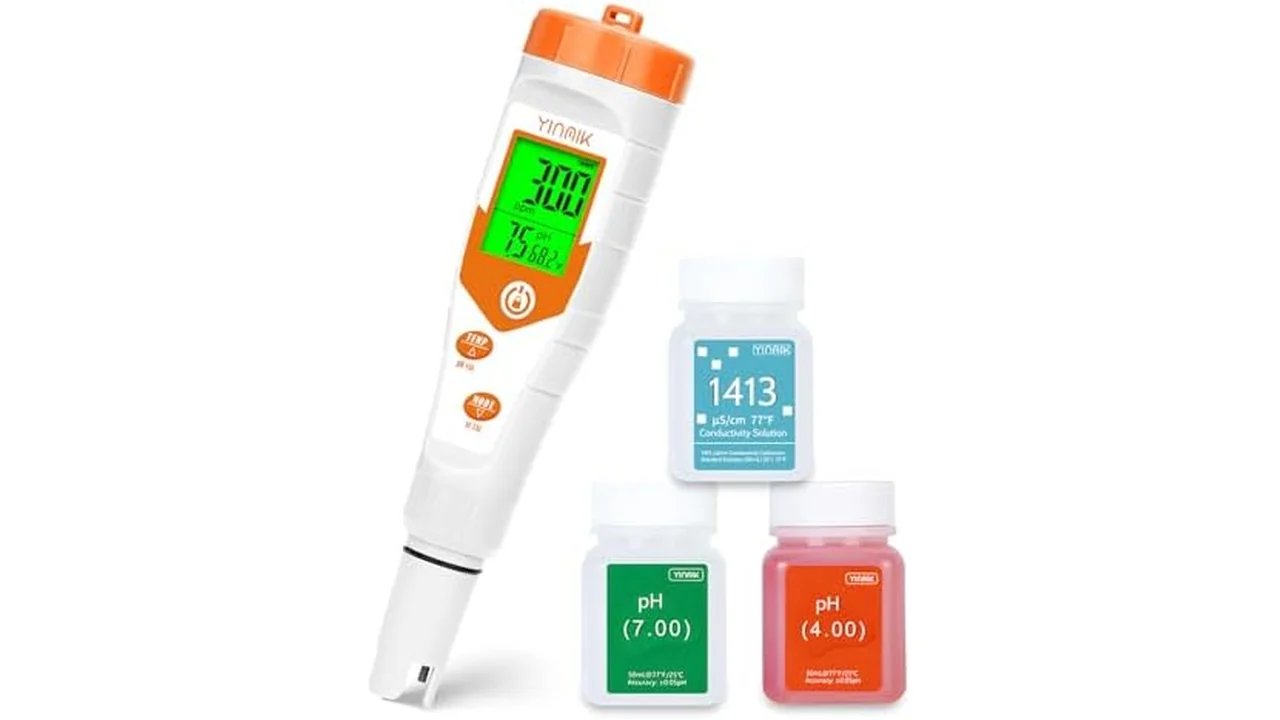
- Precision farming and healthy aquatic environments depend on accurate water quality readings, and the pH Meter for Hydroponics PPM EC Meter for Plant Nutrients Simultaneous Measurement of pH Conductivity TDS Temperature for Reservoir Tank Water DWC Aeroponic Garden Indoor Outdoor Growing aims to be your all-in-one solution. This device promises to simplify the complex task of monitoring your water, offering a comprehensive suite of measurements to ensure optimal conditions for your plants or aquatic life.
- Multi-function tester suitable for home use: This device is designed to be user-friendly for everyday applications, not just for industrial settings.
- Wide range of liquid compatibility: It’s not limited to just hydroponic systems; it can test planting water, swimming pool water, drinking water, tap water, well water, fermented beer wort, and fish tank water.
- Simultaneous Measurement: Capable of measuring pH, conductivity (EC), total dissolved solids (TDS), and temperature all at once, providing a holistic view of your water’s composition.
- Designed for various growing environments: Specifically mentioned for Reservoir Tank Water, DWC (Deep Water Culture), Aeroponic Gardens, and both Indoor and Outdoor Growing setups.
- Industrial & Scientific Classification: While suitable for home use, its underlying technology is rooted in industrial-grade precision, suggesting reliability.
- Test, Measure & Inspect Category: Falls under a broad category of essential tools for diligent monitoring and analysis.
- Substance Analysis Instrumentation: Positions itself as a reliable instrument for understanding the chemical makeup of liquids.
- Exceptional Versatility: The ability to test a wide array of liquids, from hydroponic nutrient solutions to swimming pools and even fermented beverages, makes this a truly adaptable tool for many users.
- All-in-One Measurement: Getting pH, EC, TDS, and temperature readings simultaneously saves significant time and effort compared to using separate meters for each parameter. This is crucial for quick and accurate assessments.
- Designed for Hydroponics and Beyond: The explicit mention of its suitability for DWC, Aeroponics, and general hydroponic gardening indicates it’s tailored for plant nutrient management.
- User-Friendly Approach: Categorized as a “home use” tester, it suggests that the interface and operation are likely designed to be accessible to individuals without extensive scientific backgrounds.
- Comprehensive Water Analysis: The combination of pH, EC, and TDS provides a detailed snapshot of water quality, essential for understanding nutrient levels and potential contaminants.
- pH Measurement: The pH reading is fundamental for understanding the acidity or alkalinity of water, directly impacting nutrient uptake in plants and the health of aquatic life.
- Conductivity (EC) Measurement: Electrical Conductivity (EC) is a direct indicator of the total dissolved salts and ions in water. In hydroponics, this correlates directly to the concentration of nutrient solutions.
- TDS Measurement: Total Dissolved Solids (TDS) is closely related to EC and measures the combined total of all organic and inorganic substances dissolved in water. It’s another vital metric for assessing water purity and nutrient content.
- Temperature Measurement: Water temperature significantly affects dissolved oxygen levels, plant metabolic rates, and the efficiency of nutrient absorption. Having this reading integrated is highly beneficial.
- Simultaneous Data Display: The key performance advantage is the concurrent display of all these measurements, allowing for immediate correlation and informed decision-making without switching between devices.
- Broad Application Range: Its performance is not confined to a single niche; it’s designed to deliver reliable results across diverse liquid types, from plant systems to aquariums and even for general water quality checks.
- Hydroponic Growers: Ideal for anyone engaged in hydroponic gardening, including Deep Water Culture (DWC) and Aeroponic systems, where precise control over nutrient levels (measured by EC and TDS) and pH is paramount for plant health and yield.
- Aquarium Enthusiasts: Perfect for maintaining optimal water conditions in fish tanks and aquatic ecosystems by monitoring pH and TDS to ensure the well-being of fish and other aquatic organisms.
- Homebrewers: Useful for measuring the pH and TDS of brewing water, which can significantly influence the taste and quality of fermented beverages like beer.
- Swimming Pool Owners: Can be used for regular testing of swimming pool water to maintain the correct pH and mineral content for safety and clarity.
- Well Water and Tap Water Testers: Suitable for individuals who want to regularly check the quality of their drinking water, tap water, or well water for various dissolved substances and pH levels.
- General Water Quality Monitoring: Anyone who needs to test any liquid for pH, EC, or TDS will find this meter to be a versatile and convenient solution.
- Simultaneous Measurement Capabilities: Prioritize devices that can measure multiple parameters (pH, EC, TDS, temperature) at once, as this saves significant time and provides a holistic view of water quality.
- Broad Application Range: Look for a tester that specifies compatibility with various liquids, such as hydroponic solutions, tap water, pool water, and aquarium water, ensuring versatility.
- Accuracy and Resolution: While specific accuracy figures aren’t provided in the basic feature list, research reviews for insight into the device’s precision for your intended use.
- Ease of Use: For home use, a straightforward interface, clear display, and simple calibration process are essential.
- Durability and Build Quality: Consider how well the device is constructed, especially if it will be used in potentially wet or outdoor environments.
- Intended Use: Clearly define why you need the meter. If it’s primarily for hydroponics, ensure it excels at measuring nutrient solutions. If it’s for a broader range of applications, versatility is key.
- Calibration: Understand the calibration process. Most pH meters require regular calibration with buffer solutions to maintain accuracy. Check if calibration solutions are included or need to be purchased separately.
- Power Source: Determine the type of batteries or power source the device uses and their expected lifespan.
- Display Clarity: A clear, easy-to-read display is crucial, especially when taking readings in various lighting conditions.
- Brand Reputation and Reviews: Look into user reviews and the manufacturer’s reputation for reliability and customer support.
Key Features That Stand Out
This versatile testing pen goes beyond basic pH measurements, offering a truly multi-functional approach to water quality assessment. Here are the standout features:

pH Meter for Hydroponics PPM EC Meter for Plant Nutrients Simultaneous Measurement of pH Conductivity TDS Temperature for Reservoir Tank Water DWC Aeroponic Garden Indoor Outdoor Growing
What We Like
Based on the provided product information, several aspects of this device make it a compelling choice for those needing comprehensive water testing.
Performance Analysis
The pH Meter for Hydroponics PPM EC Meter for Plant Nutrients Simultaneous Measurement of pH Conductivity TDS Temperature for Reservoir Tank Water DWC Aeroponic Garden Indoor Outdoor Growing offers a robust set of functionalities that are critical for various water monitoring needs. Its core performance revolves around its ability to provide simultaneous readings for key water quality parameters.
Best For
This multi-functional meter is an excellent tool for a variety of users and applications, particularly those who demand accurate and comprehensive water quality data.
Buying Guide
When looking to purchase a comprehensive water testing device like the pH Meter for Hydroponics PPM EC Meter for Plant Nutrients Simultaneous Measurement of pH Conductivity TDS Temperature for Reservoir Tank Water DWC Aeroponic Garden Indoor Outdoor Growing, consider these factors to ensure you get the best value and performance for your needs.
Key Features to Look For
Important Materials
The product information doesn’t detail the specific materials used in its construction. However, for a water testing meter, expect it to be made from durable plastics that are resistant to corrosion and water exposure. The probe or sensor material is critical for accuracy and longevity; typically, these are made from specialized alloys or glass.
Essential Factors to Consider
Budget Planning
The price point for multi-functional pH/EC/TDS meters can vary significantly. Basic models for home use might range from $20-$50, while more advanced or professional-grade devices can cost upwards of $100 or more. This particular device appears to be positioned for accessible home and hobbyist use, suggesting a mid-range budget would likely be appropriate. Consider the cost of replacement probes and calibration solutions as part of your long-term budget.
When to Buy
The best time to buy a water testing meter is when you identify a specific need. For hydroponic growers, purchasing before the start of a growing season or when transplanting is crucial for establishing optimal nutrient levels. For pool owners, regular testing throughout the swimming season is recommended. There are generally no significant seasonal sales specifically for these types of meters, but keeping an eye out during major shopping holidays like Black Friday or Prime Day might yield discounts.
Frequently Asked Questions
What is the accuracy of the pH readings?
While the specific accuracy of the pH readings is not detailed in the provided features, multi-function testers generally offer a reasonable level of accuracy suitable for home and hobbyist use. For critical applications, it’s always recommended to calibrate regularly.
Does the meter come with calibration solutions?
The product description does not explicitly state whether calibration solutions are included. It is common for some meters to come with basic calibration packets, while others require them to be purchased separately.
How often should I calibrate the meter?
Calibration frequency depends on usage and accuracy requirements. For general use, calibrating monthly is often sufficient, but for precise applications, calibrating before each significant testing session is advisable.
Can I use this meter for soil testing?
This meter is designed for liquid testing and is not suitable for direct soil measurement. Soil pH testers typically use a different probe design.
What is the lifespan of the probe?
The lifespan of a probe can vary greatly depending on usage, care, and the type of liquids it measures. Proper cleaning and storage after each use can significantly extend its life.
Is the meter waterproof?
The product description does not specify if the entire unit is waterproof. However, it is designed for use with liquids, so the probe and sensor area should be water-resistant.
How do I read EC and TDS?
EC (Electrical Conductivity) is usually measured in units like mS/cm or µS/cm, indicating how well the water conducts electricity due to dissolved ions. TDS (Total Dissolved Solids) is often presented in ppm (parts per million) and is a measure of the total mass of dissolved substances.
Final Thoughts
The pH Meter for Hydroponics PPM EC Meter for Plant Nutrients Simultaneous Measurement of pH Conductivity TDS Temperature for Reservoir Tank Water DWC Aeroponic Garden Indoor Outdoor Growing stands out as a highly versatile and convenient tool for anyone needing to monitor water quality. Its ability to simultaneously measure multiple key parameters makes it an efficient and valuable asset for both plant enthusiasts and those maintaining aquatic environments.