Tomato plant problems can turn a hopeful gardener’s dream of a bountiful, sun-ripened harvest into a season of frustration. You provide the sun, the soil, and the water, yet your plants respond with yellowing leaves, spotted fruit, or a general failure to thrive. It can feel like a losing battle. But what if the ultimate, effortless fix wasn’t a magic spray or a secret fertilizer, but rather a simple shift in approach? The real solution lies in understanding what your tomato plants are trying to tell you and building a foundation of care that prevents most issues before they even start.
This comprehensive guide will walk you through the entire process, from establishing a resilient garden to diagnosing and treating the specific troubles that arise. By focusing on prevention and early detection, you can transform your tomato patch into a low-maintenance, high-yield success story.
The Foundation: Preventing Problems Before They Begin
The most “effortless” way to deal with tomato issues is to create an environment where they are less likely to occur. A strong, healthy plant is its own best defense against pests and diseases. Investing a little time upfront in these foundational steps will save you countless hours of troubleshooting later.
1. Start with the Right Soil
Everything begins with the soil. Tomatoes are heavy feeders and require nutrient-rich, well-draining soil to build a strong root system and robust foliage.
Enrich with Compost: Before planting, amend your garden beds or containers with several inches of high-quality compost. Compost improves soil structure, aids in water retention, provides a slow release of essential nutrients, and introduces beneficial microbes that help fight off soil-borne pathogens.
Ensure Proper Drainage: Tomato roots hate sitting in waterlogged soil, which can lead to root rot and fungal diseases. If you have heavy clay soil, incorporate organic matter like compost or peat moss to lighten it. For container gardening, ensure your pots have ample drainage holes.
Check the pH: Tomatoes prefer slightly acidic soil with a pH between 6.2 and 6.8. You can buy a simple soil test kit from any garden center. If your soil is too alkaline, you can amend it with sulfur; if it’s too acidic, lime can be added.
2. Choose Disease-Resistant Varieties
Modern horticulture has given us tomato varieties bred specifically to resist common diseases. When purchasing seeds or seedlings, look for letters after the plant’s name on the tag. These indicate resistance to specific ailments:
V: Verticillium Wilt
F: Fusarium Wilt (FF means resistance to races 1 and 2)
N: Nematodes
T: Tobacco Mosaic Virus
A: Alternaria Stem Canker (Early Blight)
Choosing a variety with VFN resistance, for example, gives you a powerful head start against some of the most devastating soil-borne diseases.
3. Give Them Space to Breathe
It’s tempting to squeeze as many plants as possible into a small space, but overcrowding is a direct invitation for disease. Proper spacing ensures good air circulation around each plant, which allows leaves to dry quickly after rain or morning dew. This simple step is one of the most effective ways to prevent the spread of fungal diseases like Early Blight and Septoria Leaf Spot. As a general rule, allow at least 24-36 inches between determinate (bush-type) tomato plants and 36-48 inches between indeterminate (vining-type) plants.
4. Water Wisely and Consistently
Improper watering is the root cause of many common tomato troubles, including fruit cracking and blossom end rot.
Water Deeply and Infrequently: Aim to provide about 1-1.5 inches of water per week, either from rainfall or irrigation. A deep, thorough soaking once or twice a week is far better than a light sprinkle every day. This encourages roots to grow deeper into the soil, making the plant more resilient to drought.
Water the Soil, Not the Leaves: Wet foliage is a breeding ground for fungal spores. Use a soaker hose, drip irrigation, or a watering can aimed directly at the base of the plant. If you must use a sprinkler, water early in the morning so the sun has plenty of time to dry the leaves.
Mulch is Your Best Friend: Apply a 2-3 inch layer of organic mulch (straw, shredded leaves, or wood chips) around the base of your plants. Mulch helps retain soil moisture, preventing the wild wet-dry swings that cause fruit problems. It also suppresses weeds and prevents soil-borne pathogens from splashing up onto the lower leaves.
Diagnosing Common Tomato Plant Problems
Even with the best preventative care, issues can still pop up. The key is to identify them early and act swiftly. Here’s a breakdown of common symptoms, their likely causes, and the best course of action.
Category 1: Leaf Issues
Your plant’s leaves are its primary communicators. Paying close attention to them will give you the first clues that something is amiss.
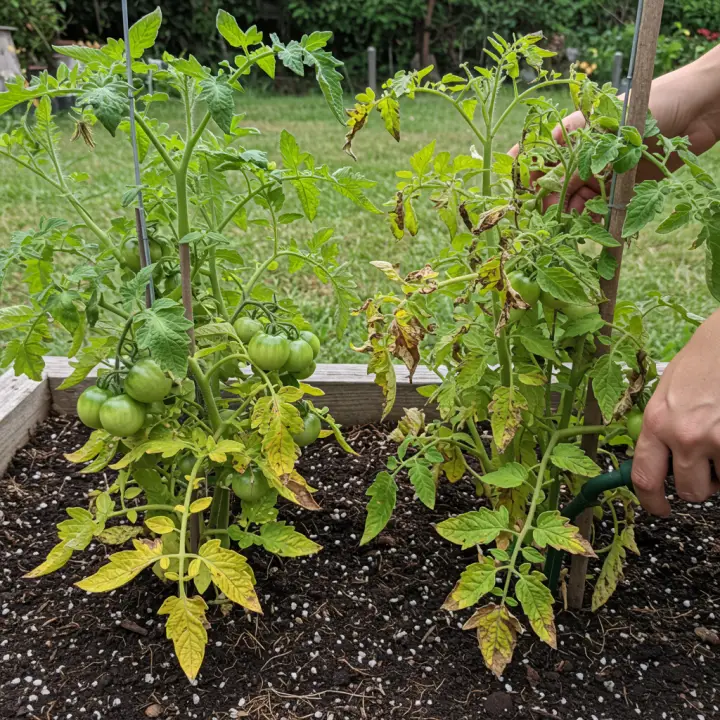
Problem: Yellowing Leaves at the Bottom of the Plant
Symptoms: The oldest, lowest leaves turn yellow and may eventual
ly drop off, while the new growth at the top looks healthy.
Cause: This is often a sign of a nitrogen deficiency. As a mobile nutrient, the plant will pull nitrogen from its older leaves to feed the new growth. It can also simply be the natural aging process of lower leaves being shaded out.
The Fix: If the yellowing is progressing up the plant, feed it with a balanced, nitrogen-rich liquid fertilizer, like fish emulsion or a commercial vegetable fertilizer. If it’s just one or two leaves at the very bottom, simply prune them off.
Problem: Dark Spots with Yellow Halos (Blight)
Symptoms: You notice small, brown to black spots on the lower leaves, often surrounded by a yellow ring. These spots may grow into a “target” or bullseye pattern. This is a classic sign of Early Blight (Alternaria). A similar issue, Septoria Leaf Spot, presents as many small, dark spots with tan or gray centers.
Cause: These are fungal diseases whose spores live in the soil and spread to the plant via water splash. They thrive in wet, humid conditions.
The Fix: Immediately prune off all infected leaves and stems. Dispose of them in the trash, not the compost pile. To prevent further spread, treat the plant with an organic fungicide containing copper or Bacillus subtilis. Increase air circulation by pruning some of the inner stems.
Problem: Leaves are Curling or Rolling
Symptoms: The edges of the leaves roll upward, forming a cup shape.
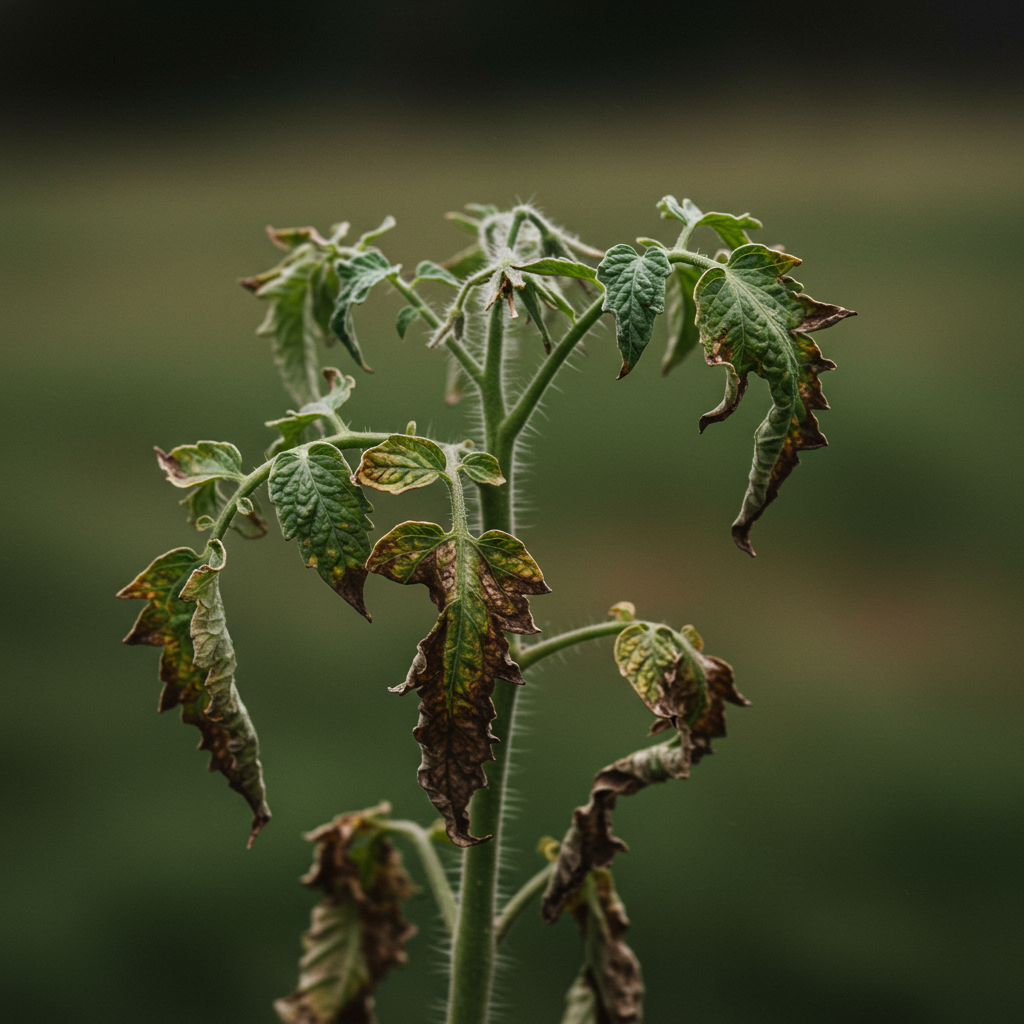
Cause: This has several potential causes. Physiological leaf roll is a temporary response to environmental stress like extreme heat, excessive moisture, or transplant shock. It looks alarming but is usually harmless. However, leaf curl can also be caused by herbicide drift from nearby lawns or farms, or by an infestation of aphids on the undersides of the leaves.
The Fix: First, check for pests. If you see aphids, a strong blast of water o
r a treatment with insecticidal soap will work. If there are no pests, assess the environmental conditions. Provide shade during the hottest part of the day and ensure watering is consistent. If you suspect herbicide damage (often characterized by twisted, deformed new growth), the damage is done but the plant may recover if the exposure was minimal.
Category 2: Fruit and Blossom Issues
Nothing is more disheartening than seeing your promising green tomatoes develop problems as they ripen.
Problem: Dark, Leathery Spot on the Bottom of the Fruit
Symptoms: A dark, sunken, rotten-looking patch develops on the blossom end of the tomato (the side opposite the stem).
Cause: This is Blossom End Rot, and despite its appearance, it is not a disease. It’s a physiological disorder caused by a calcium deficiency in the fruit. This is almost never due to a lack of calcium in the soil; rather, it’s caused by inconsistent watering that prevents the plant from properly transporting calcium to the rapidly developing fruit.
The Fix: You cannot save the affected fruit; pick it and discard it. To prevent it on future fruit, focus on maintaining consistent soil moisture. Mulching is critical here. Avoid letting the soil dry out completely between waterings.
Problem: Deep Cracks in the Fruit
Symptoms: You see vertical (radial) or circular (concentric) cracks appearing on the shoulders of the fruit, especially as it ripens.
Cause: Like blossom end rot, fruit cracking is related to inconsistent watering. It happens when a dry period is followed by heavy rain or watering. The fruit’s inner pulp grows faster tha
n its outer skin can stretch, causing it to split.
The Fix: Again, consistent moisture is the cure. Mulch and a regular watering schedule are your best tools. Some heirloom varieties are more prone to cracking; harvesting them just before they are fully ripe can help.